Noesis

NOESIS

MANIFEST WITH SCIENCE

Download on the App Store The science, below

The stance

The manifestation app that doesn't lie to you.

Manifestation is not magic. It is the structured practice of clarifying what you want, training your brain to notice and pursue it, and taking courageous action to make it real. Noesis turns that practice into a daily protocol, and shows you the peer-reviewed evidence behind every minute of it.

The method

One practice. Four tabs.

Noesis brings one practice into four connected tabs. You regulate and rehearse, you take meaningful action, you train your attention, and you build believable self-talk. Each tab has a clear function and a path back to real life.

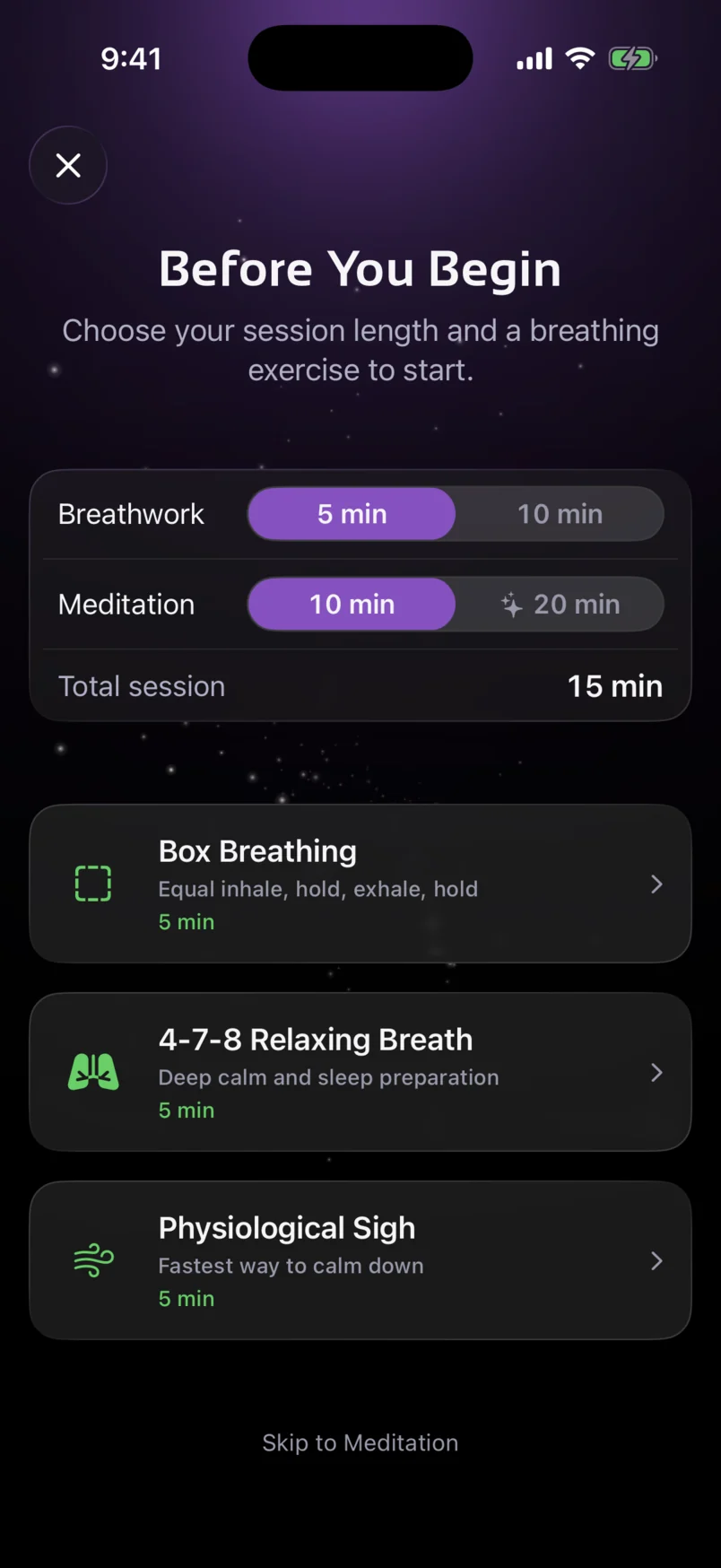
Meditation setup screen for choosing breathwork and meditation duration before a personalized session

Meditate

Rehearse the future until your brain treats it as familiar.

Every session opens with grounding, because a stressed brain cannot encode anything new: slow, exhale-weighted breathing brings the prefrontal cortex back online. Then comes the rehearsal, a personalized visualization of your goal in first person, present tense, across all five senses.

The evidence

Five days of purely mental piano practice reorganized the motor cortex almost as much as physical practice.

Journal of Neurophysiology · 1995 · Pascual-Leone et al. Read the study

Twelve weeks of imagined muscle contractions raised real strength by about 35 percent, through a stronger brain-to-muscle signal.

Neuropsychologia · 2004 · Ranganathan et al. Read the study

Five minutes of daily structured breathwork improved mood more than mindfulness meditation in a controlled trial.

Cell Reports Medicine · 2023 · Yilmaz Balban et al. Read the study

Meditation setup screen for choosing breathwork and meditation duration before a personalized session

The flagship

Not a meditation library. A mental movie of your life, one chapter ahead.

It starts with your words

You give Noesis the goal, why it matters, and the exact sensory moment you are working toward. It writes a script around them, unique to you, never from a library.

Engineered like a rehearsal, not a fantasy

Centering, five-sense immersion, emotional anchoring, your own affirmations, a slow return. Research shows outcome fantasy alone saps drive, so the movie rehearses the doing and ends pointed at action.

Narrated by you, if you choose

A coach voice or a clone of your own voice reads it back over a live soundtrack. Generated in about a minute, cached for offline, and delivered fresh every week as your goal evolves.

Roughly two thirds of early visual cortex activates during vivid mental imagery.

Nature Reviews Neuroscience · 2001 · Kosslyn et al. Read the study

Imagining the future runs on the same machinery the brain uses to remember the past.

Nature Reviews Neuroscience · 2007 · Schacter et al. Read the study

The more people fantasized about outcomes, the less effort they invested. Rehearsal has to stay tied to action.

JPSP · 2002 · Oettingen & Mayer Read the study

Affirmations

Self-talk that stays inside what you can believe.

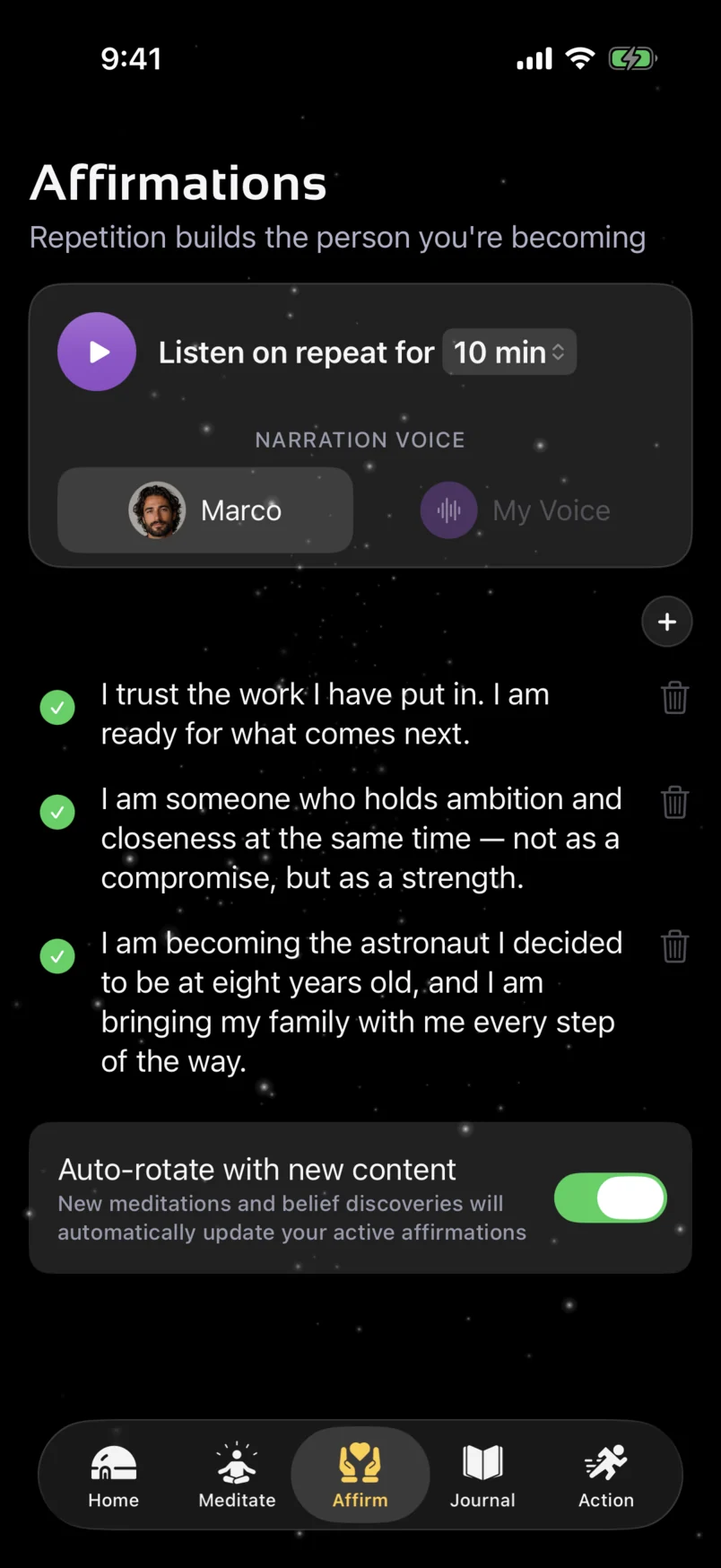
Repetition alone rewires nothing. Affirmations work when they sit inside your believability window, so Noesis builds them from your own belief work, words them so your brain does not file them as lies, and speaks them back to you on a schedule, in a coach voice or your own.

The evidence

Self-affirmation engaged self-processing and reward circuitry, and predicted real behavior change afterward.

Social Cognitive and Affective Neuroscience · 2016 · Cascio et al. Read the study

Repeating "I am a lovable person" left low-self-esteem participants feeling worse. Noesis is designed around this study, not past it.

Psychological Science · 2009 · Wood et al. Read the study

Hearing self-statements in your own recorded voice engages self-referential and memory networks more deeply than a stranger's voice.

Brain Sciences · 2024 · Jo, Park & Lee Read the study

Journaling

Attention is trainable. So are the hard days.

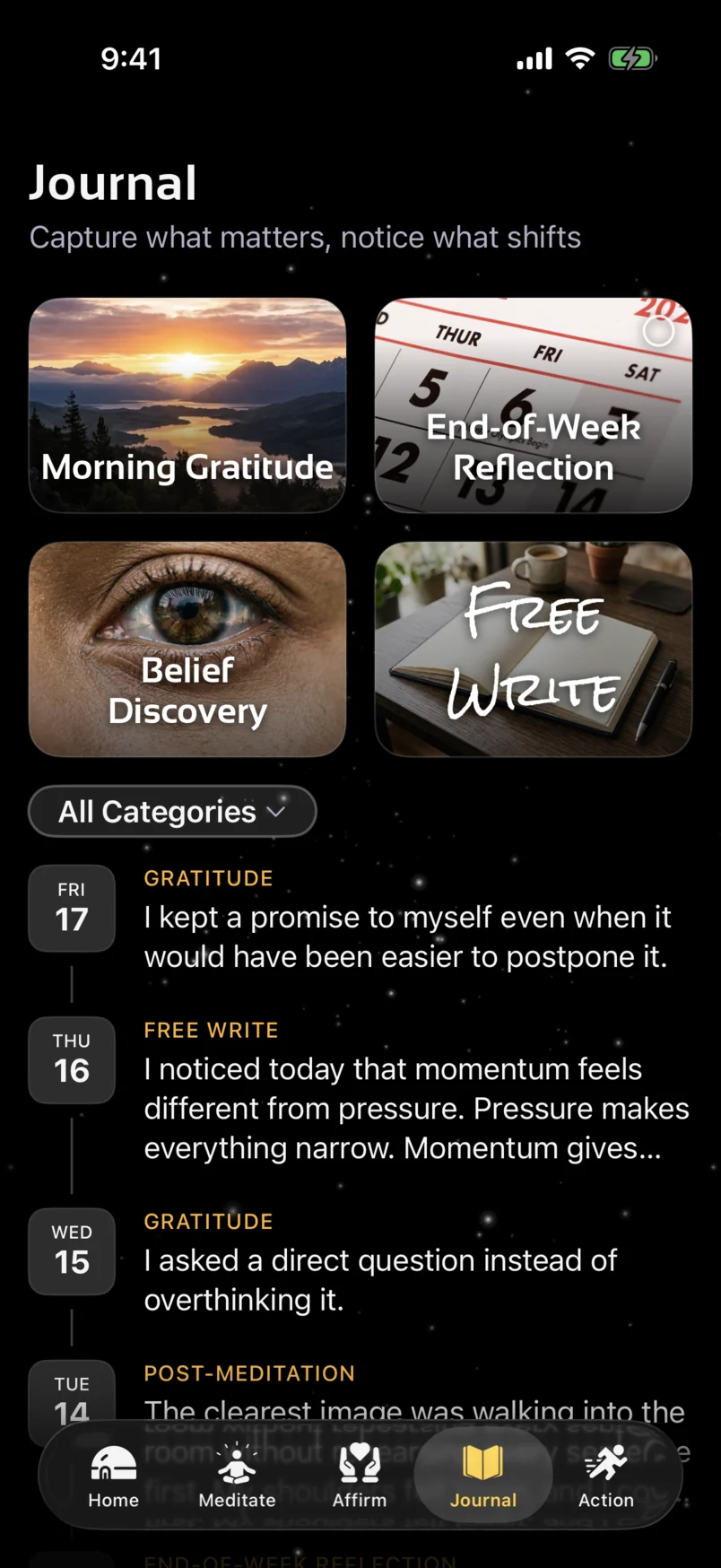
Three gratitudes a day redirect selective attention toward what is already working. Expressive writing metabolizes what is not. There is no pressure to feel good on command here: the honest entries are the ones that do the most work.

The evidence

Weekly gratitude writing improved well-being, optimism, and even exercise frequency versus writing about hassles.

JPSP · 2003 · Emmons & McCullough Read the study

Writing about difficult experiences produced durable benefits to health and performance, replicated across decades.

Psychological Science · 1997 · Pennebaker Read the study

Reappraising an emotion lowers its felt force. Suppressing it raises the body's stress load instead.

JPSP · 1998 · Gross Read the study

Action

The tab every other manifestation app skips.

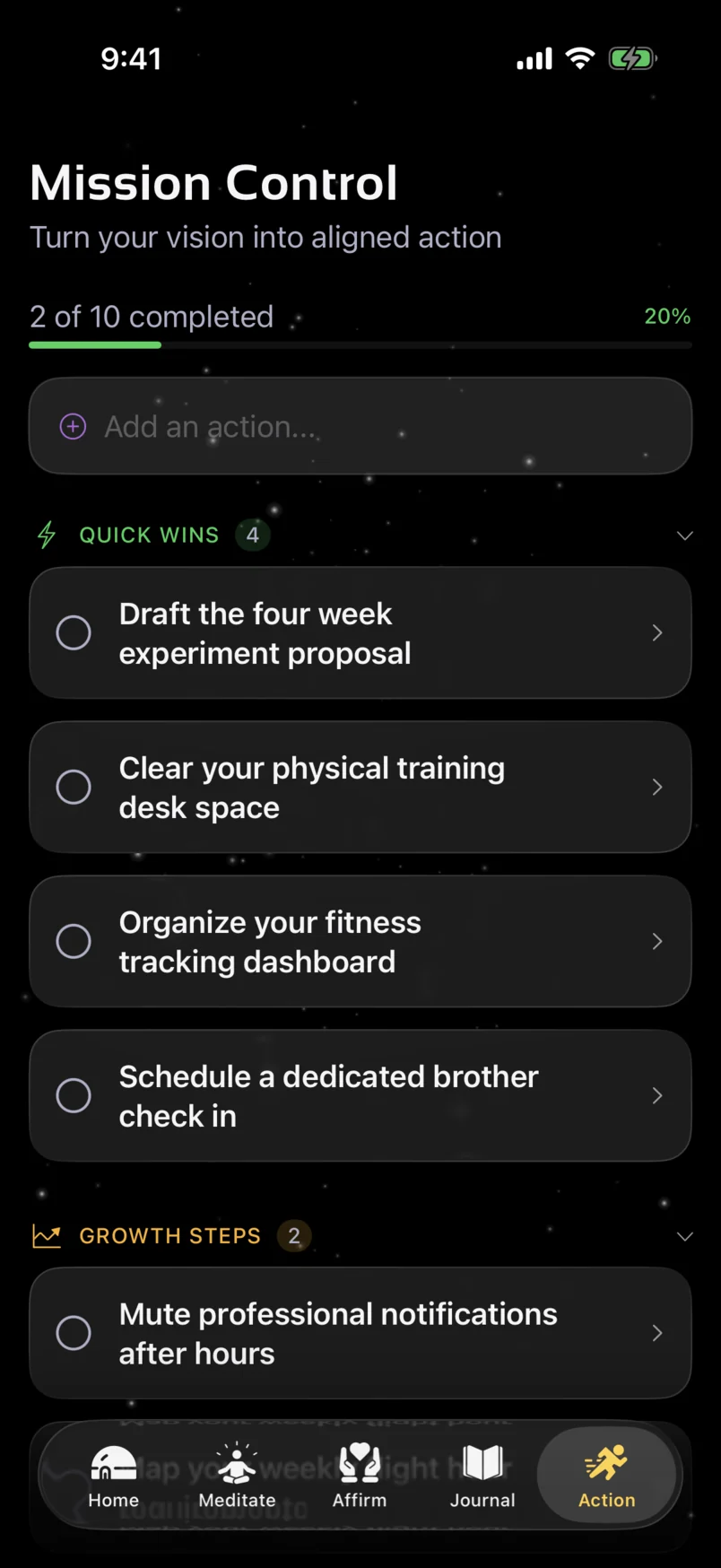
Visualization builds the template. Action is what tests it against reality. Every week Noesis turns your goal into a small set of concrete moves: quick wins, boundaries, one bold leap. Then it helps you process what acting stirred up, and feeds that back into the next cycle.

The evidence

If-then plans raised goal attainment with an effect size of d = 0.65 across 94 studies and more than 8,000 participants.

Advances in Experimental Social Psychology · 2006 · Gollwitzer & Sheeran Read the study

New habits took a median of 66 days to become automatic, and missing a single day did not derail the process.

European Journal of Social Psychology · 2010 · Lally et al. Read the study

Specific, difficult goals reliably beat "do your best" goals across 35 years of research and 40,000 participants.

American Psychologist · 2002 · Locke & Latham Read the study

Also inside

Built like a protocol, down to the details.

Your own voice

Clone your voice once and hear your affirmations and mental movies narrated by the one narrator your brain treats as self.

A coach who checks in

A weekly voice message from your chosen coach, personalized to the week you actually had, not a canned pep talk.

Streaks without shame

Progress atoms fill as you practice. Miss a day and the app meets you warmly: the research says one missed day changes nothing.

Ready when you are

Your generated visualization is cached on your iPhone after creation, so you can return to the practice even when your connection cannot.

The confidence spectrum

Every claim in the app is labeled: established science, emerging evidence, or speculative frontier. The frontier never gets sold as fact.

The receipts

We show our work.

Every claim on this page links to the journal it came from. Inside the app it works the same way: each feature tells you the mechanism it relies on and how settled the evidence is.

66

median days for a new habit to automate

d = 0.65

effect size of if-then plans across 94 studies

+35%

strength gained from purely imagined training

5 min

of daily breathwork beat mindfulness for mood

The long versions live on Field Notes, where each mechanism gets pulled apart at length, sources and caveats included.

References on this page
  1. Pascual-Leone, A., et al. (1995). Modulation of muscle responses during the acquisition of new fine motor skills. Journal of Neurophysiology, 74(3). doi:10.1152/jn.1995.74.3.1037
  2. Ranganathan, V. K., et al. (2004). From mental power to muscle power. Neuropsychologia, 42(7). doi:10.1016/j.neuropsychologia.2003.11.018
  3. Yilmaz Balban, M., et al. (2023). Brief structured respiration practices enhance mood and reduce physiological arousal. Cell Reports Medicine, 4(1). doi:10.1016/j.xcrm.2022.100895
  4. Kosslyn, S. M., Ganis, G., & Thompson, W. L. (2001). Neural foundations of imagery. Nature Reviews Neuroscience, 2(9). doi:10.1038/35090055
  5. Schacter, D. L., Addis, D. R., & Buckner, R. L. (2007). Remembering the past to imagine the future. Nature Reviews Neuroscience, 8(9). doi:10.1038/nrn2213
  6. Oettingen, G., & Mayer, D. (2002). The motivating function of thinking about the future. Journal of Personality and Social Psychology, 83(5). doi:10.1037/0022-3514.83.5.1198
  7. Cascio, C. N., et al. (2016). Self-affirmation activates brain systems associated with self-related processing and reward. Social Cognitive and Affective Neuroscience, 11(4). doi:10.1093/scan/nsv136
  8. Wood, J. V., Perunovic, W. Q. E., & Lee, J. W. (2009). Positive self-statements: Power for some, peril for others. Psychological Science, 20(7). doi:10.1111/j.1467-9280.2009.02370.x
  9. Jo, H., Park, S., & Lee, H. (2024). Own-voice self-affirmation and the self-referential network. Brain Sciences, 14(7). doi:10.3390/brainsci14070637
  10. Emmons, R. A., & McCullough, M. E. (2003). Counting blessings versus burdens. Journal of Personality and Social Psychology, 84(2). doi:10.1037/0022-3514.84.2.377
  11. Pennebaker, J. W. (1997). Writing about emotional experiences as a therapeutic process. Psychological Science, 8(3). doi:10.1111/j.1467-9280.1997.tb00403.x
  12. Gross, J. J. (1998). Antecedent- and response-focused emotion regulation. Journal of Personality and Social Psychology, 74(1). doi:10.1037/0022-3514.74.1.224
  13. Gollwitzer, P. M., & Sheeran, P. (2006). Implementation intentions and goal achievement: A meta-analysis. Advances in Experimental Social Psychology, 38. doi:10.1016/S0065-2601(06)38002-1
  14. Lally, P., et al. (2010). How are habits formed: Modelling habit formation in the real world. European Journal of Social Psychology, 40(6). doi:10.1002/ejsp.674
  15. Locke, E. A., & Latham, G. P. (2002). Building a practically useful theory of goal setting. American Psychologist, 57(9). doi:10.1037/0003-066x.57.9.705

Feel the future you're building.

Noesis is on iPhone. The research is free to read. The practice takes about ten minutes a day.

Download on the App Store